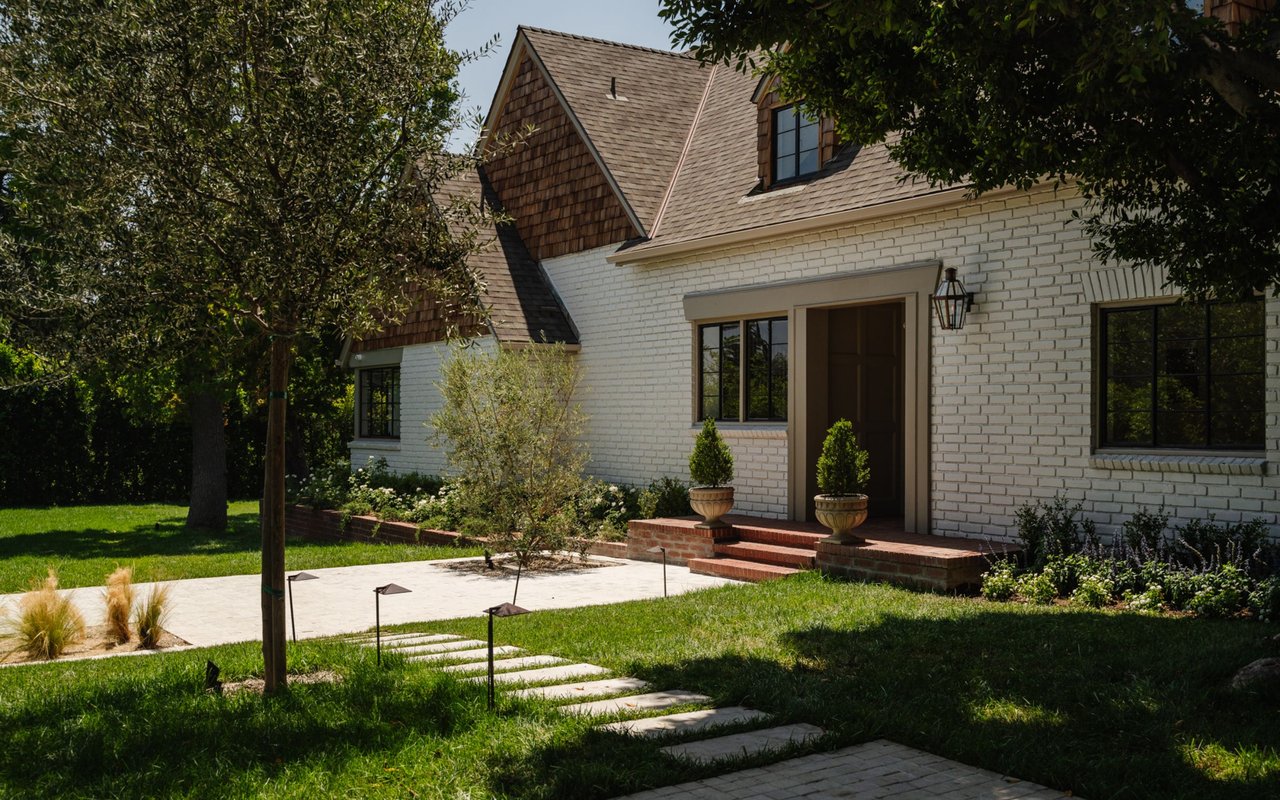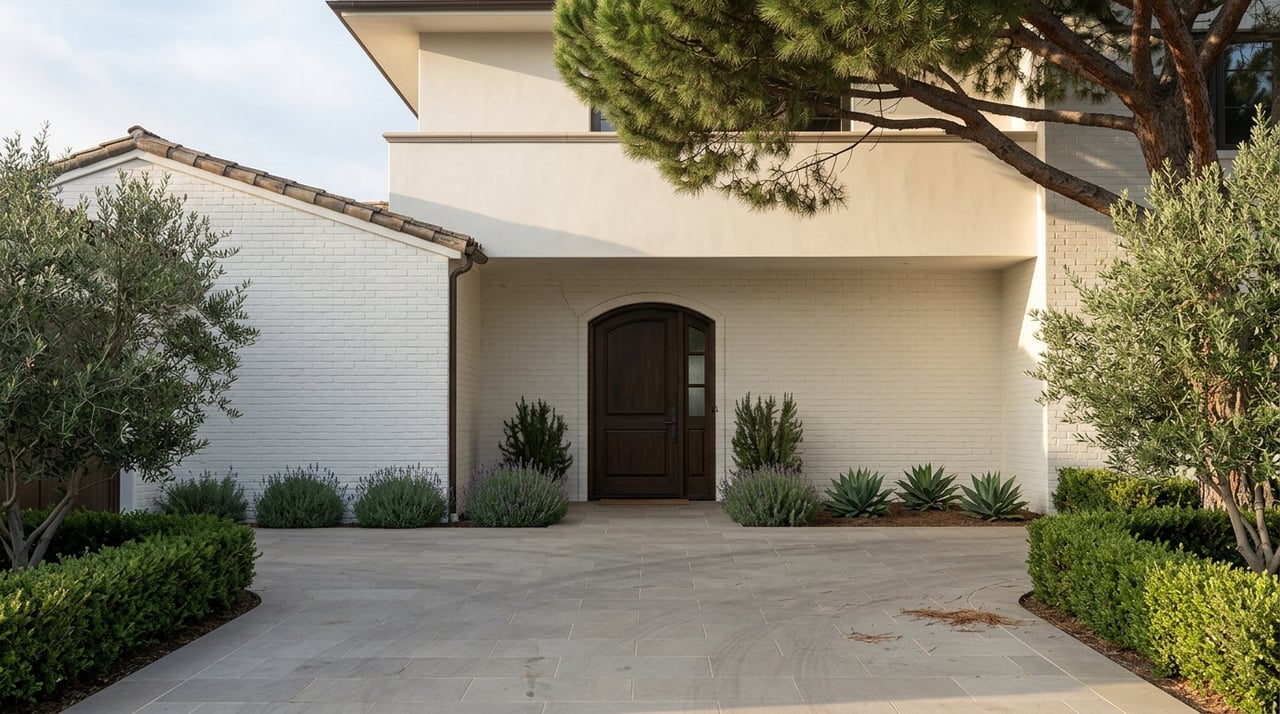
A lot at 1111 Galloway closed this year at $1.738 million. The parcel measures 6,500 square feet, which works out to $267 per square foot of land. Two years ago, a comparable lot on that same block would have traded for close to double that number. Nothing about the block changed except everything on it.
That single sale tells you more about Pacific Palisades right now than any median price you've seen on a portal. The neighborhood isn't repricing downward the way a slowing market usually does. It has split into two separate assets wearing one zip code, and most of the confusing, contradictory numbers floating around this year are just different ways of averaging them together.
The median you keep seeing is two markets pretending to be one
If you've spent any time comparing sources on Pacific Palisades this year, you've probably noticed the median sale price doesn't sit still. Depending on which report you pull and which month it covers, you'll see figures anywhere from the high $1 millions to the mid $3 millions. That spread isn't noise or bad data. It's the arithmetic of blending two structurally different transactions into a single line.
One track is standing homes: properties that survived the January 2025 fire intact and are transacting the way Palisades real estate always has, on comps, condition, and location. The other track is land: cleared parcels, sometimes with permits already in hand, trading as a distinct commodity with its own logic. When a wave of sub-$2 million land sales gets folded into the same median as $6 million move-in-ready homes, the resulting number describes neither market accurately. It describes the mixing ratio.
This matters for anyone using a published median as a starting point for a decision, because the median tells you almost nothing about what a specific address is worth. It tells you what proportion of last month's closings were dirt.
What the sub-neighborhoods actually show
Pull the data apart by pocket and the two-track story gets sharper. Listings tracked through mid-2026 showed Huntington Palisades, the mesa-top enclave of larger lots and Period Revival architecture, carrying a median listing price near $6.97 million. Marquez Knolls, the mid-century hillside tract north of the Village, sat closer to $2.83 million. Palisades Highlands, further up the canyon with a mix of condos and larger view homes, showed a median around $1.57 million.
| Sub-area | Approx. median listing (mid-2026) | Typical lot size |
|---|---|---|
| Huntington Palisades | $6.97 million | ~8,050 sq ft |
| Marquez Knolls | $2.83 million | Varies, hillside |
| Palisades Highlands | $1.57 million | Mixed, condo to estate |
| Alphabet Streets | Not separately tracked, but among the tightest land supply | ~5,200 sq ft |
None of these numbers are wrong. They're just describing different products. A flat 5,200-square-foot Alphabet Streets lot within walking distance of the Village and an 8,050-square-foot Huntington Palisades mesa parcel with ocean exposure aren't competing for the same buyer, and averaging their sale prices together produces a statistic that fits neither.
How land actually gets priced right now
The reason land prices swing so hard from block to block isn't sentiment. It's a specific calculation that developers and cash buyers run before they ever make an offer, known as residual land value. The logic works backward from the finished product:
- Start with the realistic resale value of a home built on that lot once construction is complete.
- Subtract projected construction cost for that size and finish level.
- Subtract carrying costs for the months the lot sits before and during construction, including insurance and financing.
- Subtract a builder's profit margin.
- Subtract transaction costs on both the purchase and the eventual sale.
What's left is the most a rational buyer will pay for the dirt. This is why average land pricing across the Palisades has been reported near $330 per square foot, with a spread running from roughly $72 to $520 depending on flatness, view corridor, and elevation. A flat, buildable lot with no grading issues clears the residual value math easily. A steep parcel that needs a geotechnical report and extensive retaining work eats into the same formula from the construction-cost side, which is part of why land under the Riviera's hillside frontage and land in the flatter Alphabet Streets don't move at the same rate even when they're a few blocks apart.
It also explains the Galloway comp. Construction costs and carrying costs went up sharply after the fire, which mechanically pushes the residual value of the land down, even on an identical parcel.
The insurance math quietly deciding who sells and who rebuilds
The construction-cost side of that formula has a number attached to it that most sellers didn't expect to be dealing with: the gap between what insurance actually pays and what a real rebuild costs.
Case-study analysis from ClaimArchitect, an AI-driven rebuild-estimating startup founded by a Palisades fire survivor, put that shortfall at roughly $603 per square foot, or about $1.5 million per household on average, according to reporting from The Real Deal. That gap is the quiet mechanism sending so much land onto the market in the first place. A homeowner whose settlement covers most, but not all, of a $550 to $850 per square foot rebuild is making a very different decision than one whose payout covers the whole project. Selling the lot converts an uncertain, underfunded construction project into a known cash number today.
That's also the setup for the investor activity showing up in the data. Redfin and Realtor.com economists estimated in a January 2026 analysis that investors were buying 30 to 40 percent of the vacant lots trading across the Palisades and Malibu burn zones. Investors aren't more optimistic about the neighborhood than residents. They're simply not carrying the insurance gap personally, and they can run the residual value math at scale across dozens of parcels rather than one.
The insurance backdrop is about to shift again. The California Department of Insurance approved a 29.1 percent average dwelling rate increase for the FAIR Plan, effective October 15, 2026, which will change the carrying-cost line in that residual value formula for any lot still unsold when the new rates take effect.
What the Village reopening changes, and what it doesn't
Palisades Village reopened to the public on August 15, 2026, 99 percent leased, after a $100 million restoration led by developer Rick Caruso. Roughly a third of the tenant lineup is new to the property. Elyse Walker returned with a new flagship alongside her existing Towne by elysewalker, chef Nancy Silverton opened the Italian steakhouse Spacca Tutto, and LESET, Violet Grey and Xirena joined returning names like Erewhon, Zimmermann, Veronica Beard and Blue Ribbon Sushi. Loomey's Toys, whose original location burned, relocated into the Village itself, according to coverage from ABC7 Los Angeles.
This is genuinely useful information for a land-versus-home decision, but not because a reopened shopping center adds value to every parcel equally. It matters because walkability was already the variable separating the flat, Village-adjacent pockets from the hillside and bluff areas, and a fully operating commercial core makes that separation more visible in the numbers, not less. A cleared lot two blocks from Palisades Village and a comparable lot up in Marquez Knolls were never going to price identically, and a reopened anchor tenant base sharpens that gap rather than closing it. The commercial recovery is real. It just isn't a neighborhood-wide rising tide.
Reading a specific address instead of the neighborhood
None of this changes the fundamentals that made Pacific Palisades desirable before January 2025: coastal proximity, canyon access, and a walkable commercial core that just reopened at scale. What's changed is that the neighborhood-level median has temporarily stopped being a useful shortcut. A buyer or seller working with a Palisades property this year needs the answer to a narrower question than "what's the median," specifically: is this asset priced against other land, or against other finished homes, and which sub-pocket's comps actually apply.
That's a harder question to answer from a portal search bar than it used to be. It's not a harder question for someone who's been tracking these blocks parcel by parcel since before the fire.
A few direct questions
Is land still cheaper than it was a year ago, or has it started to recover? Reported figures through mid-2026 still show wide dispersion by sub-area and lot condition, with land pricing running from $72 to $520 per square foot depending on flatness, view, and elevation. There's no single answer that applies neighborhood-wide, which is the core issue this piece is addressing.
Does the FAIR Plan rate increase affect lots that are already under contract? The October 15, 2026 rate change applies going forward to new and renewed policies. It's a factor to model into carrying costs for any lot still in the pipeline rather than something that retroactively changes closed transactions.
If Palisades Village is back, does that mean the whole neighborhood has recovered? The reopening restores one major commercial anchor that had been closed for 19 months, but a large share of the community's other commercial buildings, including the Spanish Colonial-style Business Block near the Village, are still awaiting reconstruction. Recovery is proceeding unevenly by location, which is consistent with the land-versus-home pricing pattern described above.
If you're trying to figure out which side of this market a specific Pacific Palisades property sits on, and what that means for your timeline, Sandler + Hirsch Group can walk you through the comps that actually apply to your address. Request a private home valuation to start that conversation.